The five World of Tanks vehicle classes, compared
This article is funded by advertising. Some links on this page are partner links: if you follow one and sign up or install the game, Boyuk Group, s.r.o. may be paid a commission by an affiliate network. You pay nothing extra, and World of Tanks itself remains free to download and play.
The commission does not change what is written here. Our editorial policy explains how we separate the two, and the affiliate disclosure sets out the arrangement in full.
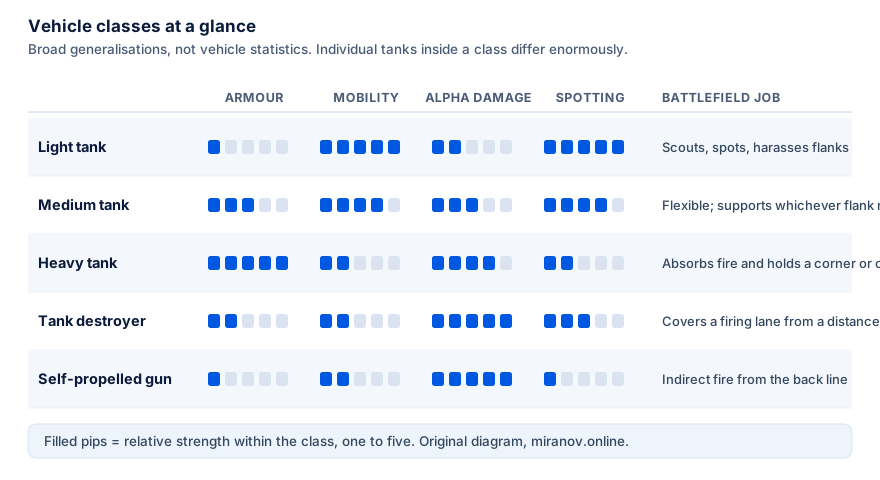
Class does not determine everything — the spread inside each one is enormous — but it tells you what the game expects you to do, and which mistakes it will punish hardest.
Light tanks
The job: find the enemy and survive long enough for your team to shoot what you found.
Light tanks are fast, thinly armoured and hard to see. Their value is measured in spotting damage — damage your teammates deal to vehicles only you can see — which the game tracks and rewards. A light tank that finishes with no kills can still be the most useful vehicle on the field.
Why they are hard: the margin for error is the smallest in the game. Being seen usually means being dead, and the skill is knowing the map well enough to reach a position that sees without being seen. Not a class for a first branch.
Medium tanks
The job: go where the battle needs you.
Mediums are the generalists: enough speed to relocate, enough armour to survive a mistake, enough gun to matter. They can support a heavy push, punish an overextended flank, or take over spotting when the lights are gone.
Why they are the sensible first choice: a medium forgives more than any other class while still teaching you every skill the game rewards — positioning, angling, vision, timing. If you are picking one branch to start, pick a medium branch.
Heavy tanks
The job: hold ground and absorb fire that would kill anything else.
Heavies take and hold the close-quarters part of a map. The skill is not the thickness of the armour — it is knowing exactly when to roll out from behind cover, fire, and get back. Two techniques do most of the work: sidescraping, sitting behind a corner at an angle so that only heavily angled side armour is exposed, and hull-down, cresting a ridge so only the turret is visible.
The trap: thick armour makes new players fearless, and a heavy that drives into the open because it feels invulnerable dies to the four guns it did not see.
Tank destroyers
The job: cover a firing lane with a gun the other classes cannot match.
Most trade a rotating turret for a bigger gun, better concealment or thicker frontal armour in a fixed casemate. Played well, a tank destroyer decides a flank without ever being shot at. Played badly, it is a slow box with no turret being flanked by a medium.
The discipline: position first, patience second. If you have to turn the whole hull to track a target, you have picked the wrong spot.
Self-propelled guns (artillery)
The job: indirect fire from the back of the map, using an overhead aiming view to drop shells onto targets other vehicles cannot reach.
Artillery punishes players who sit still in the open and breaks stalemates where an entrenched heavy cannot be shifted any other way. It has also been the single most contested thing in the game for its entire history: a substantial part of the player base would remove it outright, on the grounds that being hit from a vehicle you can neither see nor reach is unfun regardless of how well balanced the numbers are. The developers have reworked it repeatedly — reducing single-shot damage, increasing stun effects — and the argument has not gone away.
We mention this not to take a side but because a new player should know that picking artillery will occasionally get you abused in chat, and that this is about the class rather than about you.
Which to start with
| If you want… | Start with |
|---|---|
| To learn the game with the fewest frustrations | A medium tank branch |
| To be in the thick of it, with armour to lean on | A heavy tank branch |
| To play carefully and shoot from a distance | A tank destroyer branch |
| Speed and map knowledge, and you accept dying a lot | Light tanks — but not first |
| A completely different rhythm to everything else | Artillery — and know what you are signing up for |
Partner link. If you install the game through this link, Boyuk Group, s.r.o. may receive a commission from the affiliate network. It costs you nothing extra, and the game is free to download and play either way.
More on the underlying mechanics in the main article, and on getting started in the beginner’s guide.
Written by Lisa Anderson, 22 September 2026. Class characteristics checked against the publisher’s official site and wiki. Individual vehicle statistics are balance values that change between updates; where this page differs from the publisher’s own current information, the publisher’s information prevails.